A First-Timer's Guide to the Japan Traditional Kogei Exhibition
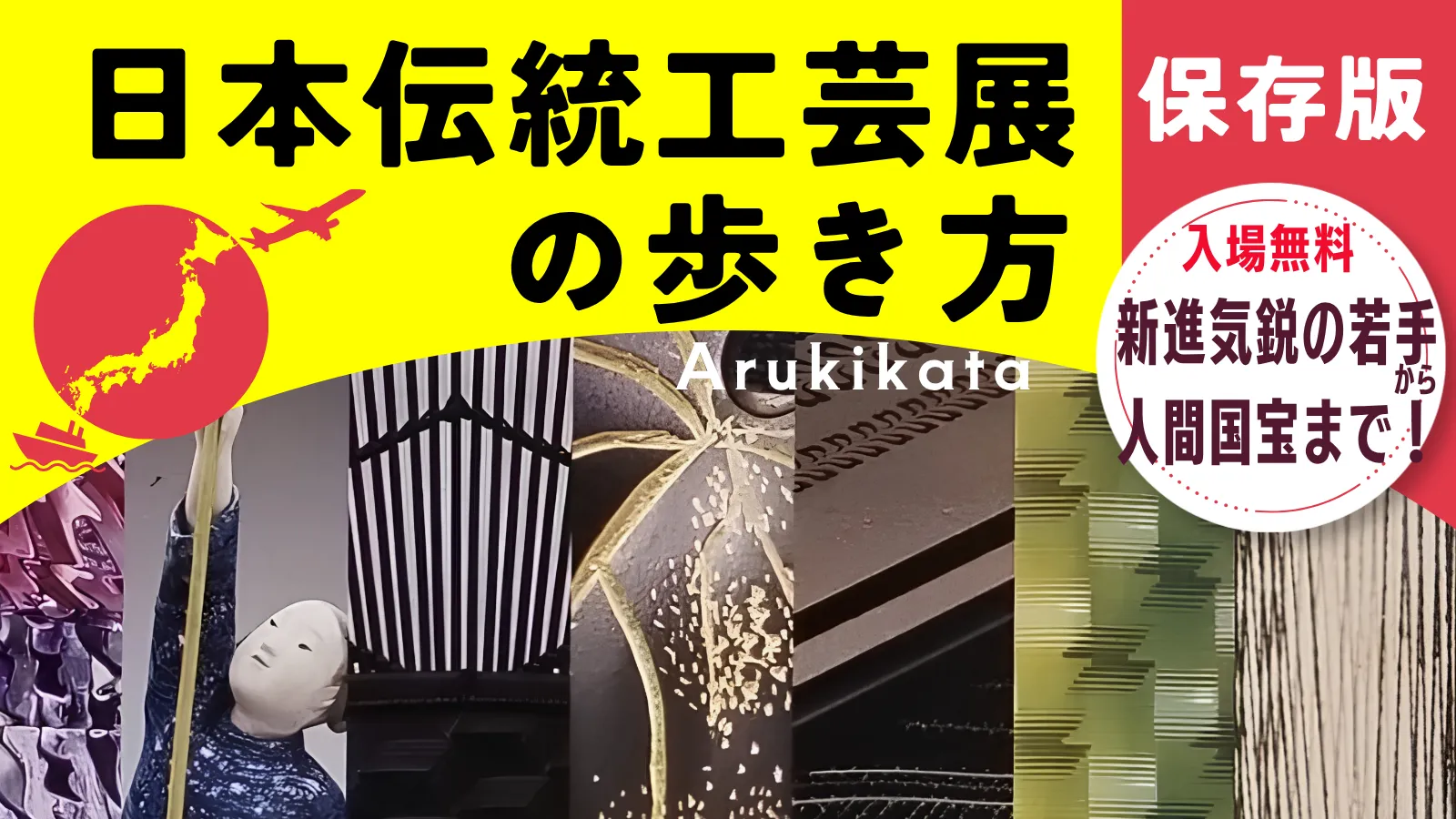
The Japan Traditional Kogei Exhibition is the largest open-call crafts exhibition in Japan, held in accordance with the aims of the Act on Protection of Cultural Properties in order to safeguard, foster and further the nation's finest traditional crafts.
It comprises seven categories—Ceramics, Textiles, Lacquer Art, Metalwork, Wood and Bamboo Work, Dolls, and Other Crafts—and only new works submitted by makers from across Japan and selected through a rigorous screening process are placed on display.
The first exhibition was held in 1954 (Shōwa 29). It began as an exhibition introducing craft techniques that had been designated as Intangible Cultural Properties, and from the seventh edition onward it has been held as a nationwide open-call exhibition. The 2026 edition marks the 73rd exhibition.
Every September, an exhibition opens on the seventh floor of Nihombashi Mitsukoshi Main Store: the Japan Traditional Kogei Exhibition. The venue is the event hall normally given over to regional produce fairs and the like. Admission is free, so you can simply drop in while out shopping.
Once inside, however, you may find yourself a little at a loss. Works carry titles such as “Bowl with Inlaid Coloured Line Design” or “Dry Lacquer Kinma Box,” which read like classical Chinese verse—or perhaps an incantation (?). Nor does the display follow a single theme or narrative along a set route, as a museum's special exhibition might. Works of every kind are lined up, category by category. I confess that on my own first visit I could do little but stand there overwhelmed, thinking “this is extraordinary……”
So this time, for those visiting the Japan Traditional Kogei Exhibition for the first time, I would like to offer a few hints that may change the way the displays look to you.
The exhibition is, in effect, a yearbook of technique and beauty
If you view it simply as “an exhibition where beautiful works are on display,” you may be enjoying only about half of what it has to offer.
The Japan Traditional Kogei Exhibition is an open-call exhibition whose purpose is to “refine the craft techniques that have been handed down, generate new expression suited to contemporary life, and present the resulting works.” In other words, I would recommend viewing it as
an exhibition in which each maker declares, through the work itself: “This is how far I have honed this technique, here and now.”
The works are of course “expression,” but what makes that expression possible is an understanding of materials and a command of technique, both refined over a very long time.
<Point>Look not only at “what is being expressed,” but at “what it was made from, and how.”
It began with the Act on Protection of Cultural Properties
Trace the background of the Japan Traditional Kogei Exhibition and you arrive at postwar cultural property policy.
The word “cultural property” brings to mind tangible things—buildings, Buddhist sculpture, paintings. But under the Act on Protection of Cultural Properties, enacted in 1950, intangible cultural properties such as the performing arts and craft techniques also became subject to protection.
On reflection this is only natural: however splendid the objects preserved, it all comes to nothing once no one is left with the skill to reproduce them.
<Safeguard and transmit not only the works, but the very state of being able to make them.>
This is the thinking that underlies cultural property protection in the crafts.
The first Japan Traditional Kogei Exhibition was held in 1954. It was, I understand, conceived as a comprehensive exhibition to introduce the craft techniques then designated as Intangible Cultural Properties; from the seventh edition it took its present form as a nationwide open-call exhibition. Today, makers from all over Japan submit new work each year, and the pieces shown are those chosen through an exacting and scrupulously fair screening and judging process (the judges, I am told, change every year).
Considering that some seventy years of annual high-water marks in craft technique and expression have accumulated here, the Japan Traditional Kogei Exhibition begins to look like “a yearbook of Japanese crafts” for that particular year.
What exactly do those incantation-like titles say?
Dry Lacquer Kinma Box
In most cases, the title of a work tells you
In that sense, a title is something like a “specification sheet” for the work. A title particular to the piece is sometimes appended after it. Once you can read them, they become genuinely absorbing.
*“Dry Lacquer Kinma Box” means a “box” made by the kanshitsu (dry lacquer) technique—in which hemp cloth is built up over a mould with lacquer to a given thickness, then removed from the mould to form the core—and decorated with the technique known as kinma.
First, the seven fields of craft
The Japan Traditional Kogei Exhibition is organised into seven broad categories. There is no need to grasp them all at once. Read the list as though you were simply forming a floor plan of the venue in your mind.
Ceramics
Tea bowls, plates, deep bowls—this is the field closest to our daily lives, and I think it is the easiest one to enter for anyone seeing the exhibition for the first time.
Even within a single medium, the body, the glaze, the firing and the decoration can alter the character of a piece to a startling degree.
Related article: A Viewer's Guide: Ceramics
Lacquer Art
Works made using urushi lacquer, broadly defined.
From lacquer coating itself to decorative techniques such as maki-e and mother-of-pearl inlay (raden), this field encompasses a wide range of methods. Many of the works are both sumptuous and exceedingly delicate, which may make it one of the most moving categories of all.
Textiles
The Japanese term senshoku joins one character for dyeing thread and one for weaving cloth. Centred on kimono and bolts of cloth, this field expresses itself through the techniques of dyeing and weaving.
Bolts are sometimes displayed made up as kimono, and there are displays where you can handle fabric samples of Edo komon, yūzen dyeing, Kokura-ori and more. It is an enjoyable corner that sets the imagination going.
Metalwork
A field in which metal is cast, hammered, chased and otherwise worked into expression.
Unlike a museum, the works here are shown without vitrines as a rule, so you can study them at close range—a real pleasure. Colour, surface texture and all, this field prompts the recurring astonishment of “was this really ever a piece of metal?”
Wood and Bamboo Work (Woodwork / Bamboo Work)
Working with the inherent properties of wood and bamboo, makers join, turn, bend and plait their material into finished works.
Personally, I am especially fond of this category.
The beauty of the material itself is one thing; but beyond that comes something hard to put into words—“is this where you arrive when the wisdom, dexterity and diligence of those who came before are compounded and sharpened over generations?”—and then
a great wordless “Ohhhhh——!!” comes rushing in.
It is very hard to convey in photographs, so please—do see these works in person!
Dolls
Today the word may call to mind dolls for the seasonal festivals, but here you will find works in a variety of materials and techniques—carved wood, paulownia-paste modelling (tōso), dry-lacquered papier-mâché (harinuki), ceramic bodies and more.
In that they are “made in the likeness of a human figure,” this may be the category among the seven where the motif is easiest to read. Works by makers who have collaborated with characters such as those of Evangelion are also shown on occasion.
Other Crafts
Glass, cloisonné enamel, inkstones and cut gold leaf (kirikane)—this category gathers the many craft techniques that do not fall within the preceding six.
It is also the field most likely to produce the discovery: “I've always loved this—so this counts as a craft!”
On a first visit, choose just two categories
Here is my own suggested way of walking the Japan Traditional Kogei Exhibition.
If it is your first time, do not try to view all seven categories properly. Some 550 works are on display, and if you set out to examine every one of them from beginning to end, you will almost certainly run out of stamina.
Instead, try choosing just the two below.
<One>
A field you already know a little
If you like tableware, take Ceramics. If you like kimono, take Textiles. If you like cut glass or cloisonné, or if you practise calligraphy, take Other Crafts. With materials you already encounter in daily life, no specialist knowledge is needed: “what an unusual form,” “I've never seen a pattern like that”—there will be a great deal you can register through the senses and the body.
<Two>
A field you have no connection with at all
Here you need no advance knowledge whatsoever. Make it a place to enjoy, through the senses alone, the astonishment of “so this is what people in Japan can do.”
The remaining five categories may be walked straight past the first time. If something catches your eye, you can always come back. The most luxurious way to use an exhibition, I think, is precisely that: to be able to come back.
<Frequently asked questions>
Q. There seems to be a similar display on the first floor of the main building—what is it?
A. That will be the special exhibition “Carrying Japan's Traditional Culture into the Future, Part 2: Works Created by Traditional Craft Artists,” held in front of the Statue of Magokoro in the central hall. This time a space has been set up for “conversations with craft artists,” where makers are present and you can speak with them directly—please see the link. ARTerrace has also supplied video content to the venue, so do stop by.
Q. Can the works be purchased?
A. Yes. Unless a work is already sold or marked not for sale, it may be purchased. As for where the prices are shown—have a look for yourself at the venue.
<A parting assignment>
While you are there, try to find one work that makes you wonder, “why was this piece selected?” “I prefer the one next to it—so why did this one take the prize?” will do just as well. One of the clues lies in technique.
<The 73rd Japan Traditional Kogei Exhibition: Details>
* Gallery talks by participating artists are also scheduled during the exhibition period. For touring venues, opening hours and other details, please consult the official information published by the Japan Kōgei Association and by each venue.
Text and research by Fujita, Marketing, ARTerrace


