Interview with the winner of the ARTerrace Award

We interviewed Mr. Akio Shimada, marquetry (“moku-zogan” in Japanese) artist

The ARTerrace Award Interview : Akio Shimada The marquetry Artist

The ARTerrace Award

Interview|Akio Shimada

The marquetry(“moku-zogan”) Artist

 
In this interview with Akio Shimada, winner of the “ARTerrace Award”, we not only look at the highlights of his award-winning artwork, but also talk about the appeal of marquetry (“moku-zogan” in Japanese), the difference between marquetry and wooden mosaic, and the state of furniture in Scandinavia and Sweden.


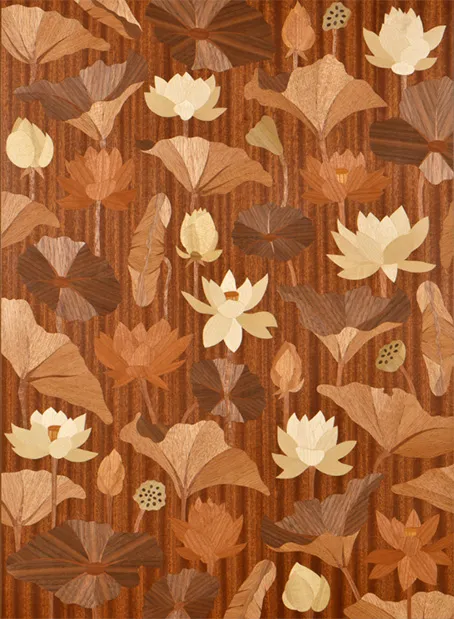
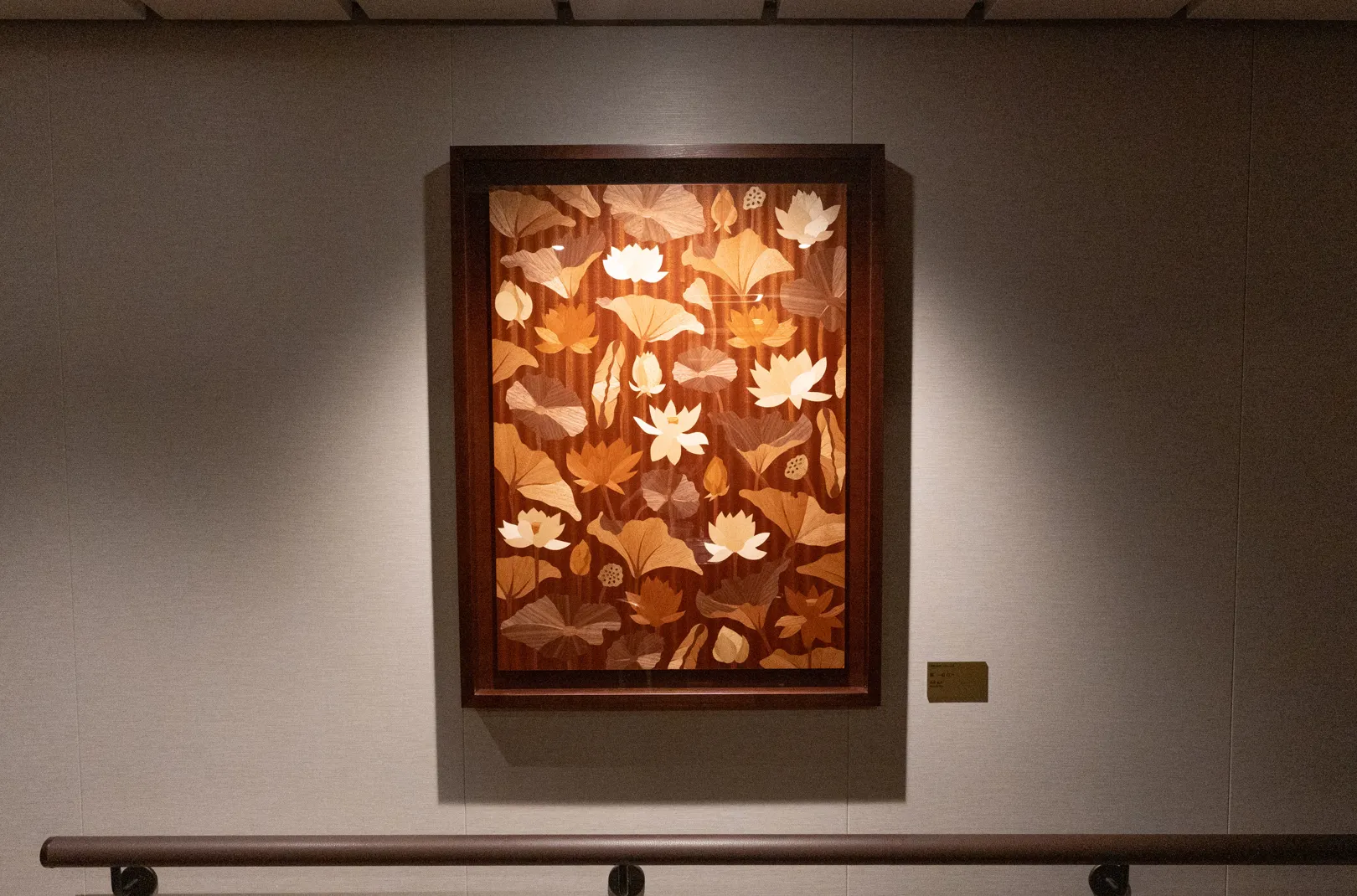
Akio Shimada's wood inlay work Lotus - Crimson and White
"Lotus - Crimson and White"


How did you feel about winning the “ARTerrace Award”?

Mr Shimada:
To be honest, I never thought I would win an award, so when I found my name on the list of winners, I felt like jumping for joy. It was particularly special for me to receive an award from a company like ARTerrace, which is deeply devoted to preserving and honoring “selected traditional artworks”. I immediately share my overwhelming joy with my family.


How did your family react?

Mr Shimada:
Actually, I hadn't told my family that I had applied, so their initial reaction was ‘What do you mean?’ (lol), but they were surprised when I explained the total number of entries and the significance of the award. My children were genuinely impressed and gave me words of encouragement, saying, ‘Next, it’s the Grand Prix’, which gave me one more goal for the future.


--We are looking forward to the next one.

What was the impetus or inspiration behind the creation of your award-winning artwork?

Mr Shimada: 
I have always made inlays with flowers and plants as my subject matter. To challenge this opportunity, I chose the lotus as my motif because it has a universal image of ‘peace’. Out of concern for wars and conflicts around the world, I created my artwork in the hope of peace. I used two colours, crimson and white, because I wanted to express the ‘world of coexistence’. In reality, lotus ponds have single-coloured flowers, but I dared to use two colours, crimson and white, in order to realise a world like an utopia. I would be happy if many people embrace the desire for peace through this artwork.


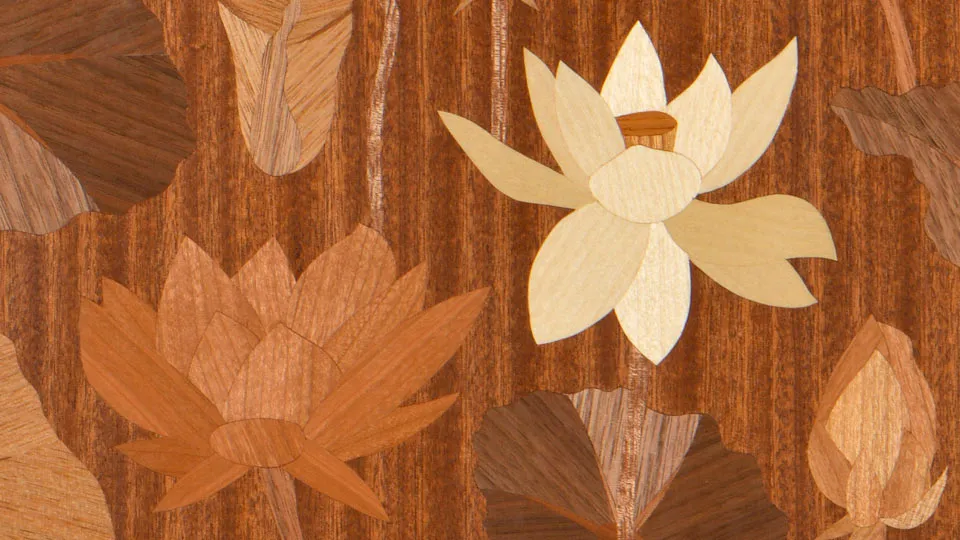
Artwork Enlargement: A Row of Crimson and White Lotus

Artwork Enlargement: A Row of Crimson and White Lotus


What were some of the particular points or challenges you faced during the creation process?

Mr Shimada: 
The thing I placed the greatest emphasis on was maintaining the quality of the work.In the repetitive highly delicate process of cutting out wood and fitting it in, I carefully utilized a design cutter instead of a thread saw to ensure that there were no gaps between each part. I also paid close attention to the combination of wood grain and colour, which subtly shifts depending on orientation – front to back, top to bottom and left to right. Furthermore, to enhance the natural beauty of the wood itself, the orientation of the wood and the way it is exposed to light are carefully considered in the design. For example, this effect becomes apparent in the petals, where the same wood is used, viewed from different angles, reflects light differently and thus alters its appearance. I use this phenomenon to give the work a sense of luminosity and three-dimensionality, beginning with the careful selection of materials that change their appearance under varying light conditions.  I leverage my technique to create an eye-catching piece of art, and created this artwork with the hope that it would inspire everyone to enjoy and become familiar with the warmth and beauty of wood.


About marquetry (wooden inlays)

What is the appeal of marquetry and how does it differ from other craft techniques?

Mr Shimada: 
I am often asked, ‘What makes it different from Hakone wooden mosaic?’ The origin is almost identical, but the techniques required are different. Inlaying is a technique where the base wood is hollowed out in the shape of a pattern, and differently colored pieces of wood are fitted into it. Yosegi(wooden mosaic), in contrast, is made by arranging pieces of wood in the shape of triangles or squares, which form the basic unit of the pattern. When sliced thinly ―with a planer, the same pattern is created, like Kintaro candy (a traditional Japanese candy that features a continuous image or pattern running through its entire length). While wooden mosaics are small in size and artworks can be completed on a desk, inlaying requires a puzzle-solving process. Each piece must be carefully lifted and fitted into place, making the process more challenging, especially for larger patterns.
 

marquetry Production Process( From the Official Website Video)

marquetry Production Process( From the Official Website Video)
 

There is more tension in marquetry because ‘if you make a mistake, you can't go back’, isn't there?

Mr Shimada:There is a lot of pressure to avoid makinge mistakes (lol). Because you can't easily switch to another material, you have to be very careful in each step of the process, such as the precise alignment of wood grain of each part. The final step is to press the presser onto the base board, but once make a mistake there, I can't take it back, so I can't relax until the final stepp is complete and the frame is firmly attached.
Even after sending it back to the customer, I still feel nervous about whether they are happy with it or not.

The artwork is delicate and shows that you put a lot of patience and skills into it.What do you find attractive about marquetry?

Mr Shimada: 
Based on the most attractive part of the wood, I can freely create beautiful silhouettes and areas that maximise the charm of the wood. I do believe this is the most attractive part of marquetry.
Since I am originally a furniture craftsman, it is natural for me to make a comparison to furniture., Furniture making primarily relies on flat surfaces and straight lines, with many restrictions during production. Even when creting furniture with curved surfaces, the process involves combining rectangular pieces and then cutting them to form curves, resulting in visible seams. In contrast, marquetry utilizes the natural curvature of the wood allowing for seamless and more organic designs without the need for joint.  Also, whereas furniture requires a uniform colour palette, marquetry allows the combination of different colours and textures of wood. Marquetry allows for the creation of large pieces, limited only by the capacity of the presses, enabling elegant decorative expressions on the surfaces of furniture. Looking back, I think it was this freedom of expression that made me fall in love with marquetry.


About the artist's activities

How did you come to focus mainly on marquetry ? Please tell us about your background.

Mr Shimada: 
I had a passion for making things.I was the kind of child who would make something in class at primary school, occasionally getting scolded by my teacher. It wasn’t until high school that I first encounteredmarquetry. I didn't even know the term ‘marquetry’ and started with the surprise of wondering what kind of techniques were used in this beautiful art form.
Since that time, I have dedicated over 30 years to researching marquetry as a hobby, neither selling nor presenting my work and refining my skills through a process of trial and error. In the early years, the internet was not widely available, and there were no masters to learn from, so I studied it completely on my own. It is only in the past decade that it has started to become a viable business. When I discovered an expert in marquetry in Sweden, I had the opportunity to study under him and ask questions about his techniques. This experience confirmed that I had been approaching marquetry correctly and validated my self-taught methods.

Was it also marquetry that led you to study in Sweden?

Mr Shimada: 
Scandinavian furniture has been a significant source of my inspiration. While at university, I started to learn about furniture from wood carvings, which deepened my appreciation for Scandinavian furniture. When my teacher at university went to Sweden, I felt a strong desire to learn by actually being in that environment rather than merely from books and photographs. 
However, the language barrier was a major challenge.. Although English is widely spoken, my supervisor's lectures were in Swedish, so I had to ask my classmates to translate them into English.

It must have been quite difficult to learn Swedish from scratch.

Mr Shimada: 
The moment I thought, 'This is so frustrating!' and seriously started learning the language wasn't in a classroom, but rather at a house party (lol). In Sweden, it is customary to have home parties on any day of the week, resulting in a lot of gatherings. I didn't enjoy that ‘supposedly fun home party environment’ at all, because I couldn't understand the conversation.
Sweden is a country with a diverse immigrant population, so there are state-run language schools available for immigrants. The school provided everything from textbooks to a single pencil for free. My classmates came from various backgrounds, including Germany, China and Russia. The schedule was hectic: language in the morning, furniture in the afternoon, language school homework in the evening... However, eventually I could understand what the radio news was talking about and had no trouble with everyday life including answering the phone.
 

―― Thanks for the language learning tips. It's unfortunate that there are so few opportunities to use Swedish in Japan.

Is Scandinavian furniture something that Japanese craftspeople admire as well?

Mr Shimada: 
 About ten years after I graduated, the Scandinavian boom was in full swing, and many Japanese individuals were studying in Scandinavia because they admired its design and craftsmanship. I heard that there was a time when so many Japanese students attended that jokes circulated about how quickly Swedes could learn Japanese, as the language was spoken throughout the school.

In terms of technique, how did you find Swedish traditional crafts?

Mr Shimada: 
Not to be patronising, but I believe that Japanese traditional crafts are of a higher level. When it comes to furniture as daily necessities, I don't think there is a significant difference in terms of technique.
However, I got the impression that there is a significant difference in the mindset between Japan and Sweden when it comes to making and using crafts.
In Japan, the design is constantly evolving and products are frequently replaced, probably driven by marketing strategies. In contrast, in Sweden and the broader Scandinavian region, products tend to remain unchanged. The designs have stayed consistent over time. For example, chairs have been made in the same way for more than a hundred years, and the situation has been established that ‘if one breaks, you just buy another’.
 
Tools Used by Mr. Shimada in Dairy production

Scandinavian and Japanese culture in furniture - ‘inheriting furniture that has been carefully used by our ancestors’ Scandinavia

Mr Shimada:
The name ‘Loppis’ is becoming increasingly common in Japan. Loppis in Sweden are like flea markets or recycling shops. You can easily find ceramics and furniture that are 100 or 200 years old in a Loppis. Customers also come to buy with the mindset that ‘one of the plates I inherited from my grandmother is broken, so I want to buy a plate of the same age’. In Scandinavia, there is a culture of taking good care of things and handing them over to future generations, which I found to be very valuable learning.  
I believe that ‘Scandinavian furniture’ has established a position as a brand in Japan and is considered one of the most popular choices. Curious about the differences between Japanese and Scandinavian furniture, I learnt that the Scandinavian culture of passing on ancestral tools is rooted in Scandinavian culture, distinguishing it from Japanese practices.. If you are told that the tableware served to a special guest is ‘a 160-year-old Copenhagen plate’, you will use cutlery with a keen awareness of not damaging the plate.

The culture of ‘inheriting tableware’ may not be common in Japan.

With the spread of industrial products and the lifestyle changing at a dizzying pace, I felt that the culture of valuing things has been somewhat forgotten in Japan.
In modern Japan, there are a few opportunities for families and relatives to get together in one place, and this is probably due to the times, but I would like to see things that are important to the family and heirlooms, things that craftspeople and artists have worked hard to create and that cannot be mass-produced, even if they are industrial products, continue to be rooted as part of Japanese culture.
As a solution, while I don't think that simply putting them in a Western art context is the right answer, there are ways to position them as a market in the art industry.
On the other hand, the difference between crafts and art lies in their use. I think that crafts should be able to call themselves crafts only if they are used as an identity of crafts. I hope more people will learn about the ‘beauty of use’ of furniture and tableware, which are passed down from generation to generation.

Future of the artist's activities

We understand that in addition to your marquetry, you also work on decorative boxes and furniture.

Mr Shimada: 
The number of requests for my marquetry has increased over the past ten years. I also produce decorative boxes (tea ceremony utensils), which are a traditional craft, since I started learning the tea ceremony about seven years ago.
Previously my focus was on fittings and furniture, but I have shifted my emphasis to marquetry and traditional crafts of the fingerwork type. When I ventured into woodworking, I explored my hand at a wide range of different genres with the aim of responding to customers' requests by saying “I can do it all”. In the course of these day-to-day production activities, I focused on ‘what I really wanted to do’, and as a result,I found my way to marquetry and traditional crafts.
 
Cabinet - Made by Akio Shimada, Designed by Carl Malmsten (Designer, Architect 1888-1972)

Cabinet
Made by Akio Shimada
Designed by Carl Malmsten (Designer, Architect 1888-1972) W:1000 × H:1824㎜

I'm curious to know why you started the tea ceremony.

Mr Shimada: 
I started the tea ceremony because I was curious about the tools involved(lol). When I studied abroad, I really felt how little I truly understood Japan. After returning to Japan, I realised that it’s hard to see what is under your nose.This prompted a desire to deepen my understanding of Japanese culture, particularly through flower arrangement and the tea ceremony. This pursuit was not easy, and I found myself busy and overwhelmed on a daily basis. I finally found the time to attend tea ceremony lessons about seven years ago, which led me to take on the challenge of making a traditional craft called a ‘decorative box’, which is a tea ceremony utensil.
I am often asked, ‘Why traditional crafts now?’ I am often asked. As I mentioned earlier, I believe that there is no need to draw a clear line between craft and art, even when it comes to the ‘beauty of use’. I believe that my marquetry can be positioned as ambiguous and ambivalent when asked whether they are craft or art.  I might as well present to you my own answer, which will eventually fuse and sublimate art and traditional craft. I have yet to find the answer, and I continue to ask myself questions as I work on refining my creations.
 
Decorative Box - Winner of the 70th Anniversary Award at the Japan Traditional Crafts Exhibition


Elm Wood Painted Decorative Box W342 D126 H12 ㎜
Elm Wood Painted Decorative Box


How should readers of this article contact you if they wish to purchase your artwork?

Mr Shimada: 
The primary sales channel for my work is through online inquiries via the internet https://d-s-shimada.com/).Additionally, my artworks are featured as part of the ‘Tobetsu-cho Furusato Tax Payment Souvenirs’.
I regularly hold a solo exhibition at Sapporo Mitsukoshi, so you can order after seeing the actual products there.
I also received our first order from Instagram the other day, from a young person in her early 40s, who had met me in person before and then used social networking to find me.


――We are very happy to be able to offer his work on ARTerrace. 

Finally, please give a message of support to the ARTerrace platform.

Mr Shimada: 
I think most of us creators specialise in ‘creating’ and don't know how to ‘sell’. We learn how to create things, and when we realise that we don't know how to sell them, we hit a wall. When I first started out on my own, I didn't even know the words ‘retail prices’ and ‘wholesale price’, and I was laughed at for not being familiar with business. How to develop an effective sales channel is a crucial issue for craftspeople, but it is probably the area in which they are the worst at. 
I see ‘ARTerrace Inc.’ as actually doing ‘craftsmanship’ in the broadest sense of the word. I was impressed to hear that all the images and interviews on their website and social networking sites are creative and extremely well finished, and that they are all produced on their own. I am very happy to receive compliments on our work, but it is even more touching when it is appreciated by people who are involved in ‘manufacturing’.At the same time, it is also very encouraging to see that as a platform, the company has achieved services in the field of marketing and sales, or ‘merchanting’, such as transmission via social networking.
I hope that ARTerrace Inc. will continue to convey the appeal of Japanese crafts and Japanese culture to people who have never heard of crafts before. I would be happy if even more people learn about marquetry as well.


A Recent Photo of Mr. Akio Shimada
 

Akio Shimada Profile

1971  Born in Tomakomai, Hokkaido
Studied woodworking at Hokkaido Otoineppu Art & Craft Highschool and Takaoka National College (Currently Toyama University).
After training in Toyama and Gifu-pref and other areas as a cabinetmaker specialist, he worked in wood working studio at the Swedish Center Foundation in Hokkaido,before moving to Sweden on his own.
1997-2000 Studied at the Capellagården School of Handicrafts for three years. Learnt local Scandinavian woodworking techniques, and after graduation worked for a year in a furniture workshop in Sweden.
2001  Returned to Japan, set up own woodworking studio(design studio shimada https://d-s-shimada.com/) in Tobetsu-cho, Hokkaido.
2007-  First Japanese national to be awarded the title of Swedish Furniture Meister.One of the few in Japan to produce marquetry works,numerous solo and group exhibitions at home and abroad.

―Awards―(marquetry)

2002 Selected, 5th Northern Living Industry Design Competition
2004 Selected, 4th Exhibition of Wooden Chairs in Daily Life
2015 NHK Kyoto Bureau Chief Award,Geibunkyo Exhibition 2015 (Kyoto)
2019 Selected, 66th Japan Traditional Crafts Exhibition
-Selected for five consecutive years
2020 Selected, 60th East Japan Traditional Crafts Exhibition
-Selected for five consecutive years
2020 Selected, 67th Japan Traditional Crafts Exhibition
2021 Asahi Shimbun Award, 61st East Japan Traditional Crafts Exhibition
2021 Selected, Traditional Crafts Wood and Bamboo Exhibition
2023 70th Commemorative Award,The 70th Japan Traditional Crafts Exhibition 


Editorial Postscript:

Shusaku Fujino, CEO/

At ARTerrace Inc., despite the large number of entries received, we set ourselves the criterion of not focusing solely on crafts when selecting the winning entries, even though our own theme of ‘communicating the excellence of crafts to the world’.
However, the moment we encountered Mr Shimada's artwork on a selection site, we were captivated by its charm. After careful and repeated discussions within the company, we finally came to the conclusion that Shimada's artwork is the best.
So-called ‘traditional crafts’ have evolved over time. Unique and innovative products are appearing on the market one after another, thanks to the ingenuity of craftspeople. On the other hand, what about the challenges for merchants, i.e. sellers? We feel that there is still a need for innovative change. We at ARTerrace Inc. are constantly striving to find solutions to these challenges by leveraging cutting-edge technology


Ayaka Fujita, Marketing-Dept. Manager /

I remember the story of Tsubame-Sanjo. I would like those who are trying to master a discipline, not just crafts, to devote as much passion and time as possible to that ‘thing they want to master’, to preserve and pass on their skills to future generations.
Moreover, as there is a precedent of Ukiyo-e, Japanese culture has a history of being protected by foreign countries in a sense. How can we convey more of the best of Japanese culture and superb craftsmanship to foreign countries...? We will transmit and respond to the needs of each country in detail, incorporating the perspective of global marketing.


Gen Ogasawara,Chief Design Officer /

I am delighted from the bottom of my heart to receive the praise of the Swedish Furniture Meister (Swedish national qualification), and I would like to say a few words! We will continue to be creative to convey the appeal of our work to those who cannot actually hold it in their hands. 
We hope that readers will take a deeper look at the artworks themselves. After admiring the various expressions, we believe that by thinking about the production process and the techniques that have been passed down through the generations, you will be able to feel the further depth and enjoyment of the artworks.