A Guide to Enjoying Ceramics — Where to Look in Pottery?
Appreciating the <Material>
In works without glaze, the very clay—the essence of the material—becomes the focal point.
To observe the clay is to discern its texture: whether coarse and grainy, or fine and smooth to the touch. Coarse clay often conveys a rustic quality that recalls the earth and mountains, while refined clay offers a pleasant tactility and an impression of clarity or elegance.
Neither is superior; each has its own appeal. What matters is how the chosen clay serves the form and the maker’s artistic intention.
In glazed works, the highlights lie in the movement of the glaze as it flows, or in the uniform sheen that envelops the surface, as seen in cobalt-blue underglaze painting.
★Key contrasts: coarse ⇔ fine / fluid ⇔ uniform
Appreciating the Form
Beyond the overall shape, one should also consider the sense of scale, the weight when held, and the balance of its center of gravity. The impression of a piece changes markedly depending on how it was shaped—on the wheel, by hand-building, or through other forming methods—as well as in the sculptural details such as pierced patterns on the sides or the contour of the rim.
Appreciating the <Decoration>
Points of interest include the motifs employed, the techniques used to depict them, the palette of colors, and the harmony of their arrangement.
When a piece lacks ornamentation or coloration, attention naturally shifts to the next perspective: meaning. It is also worth noting that in contemporary ceramics, patterns and colors may exist purely as formal expression, without conveying any symbolic significance.
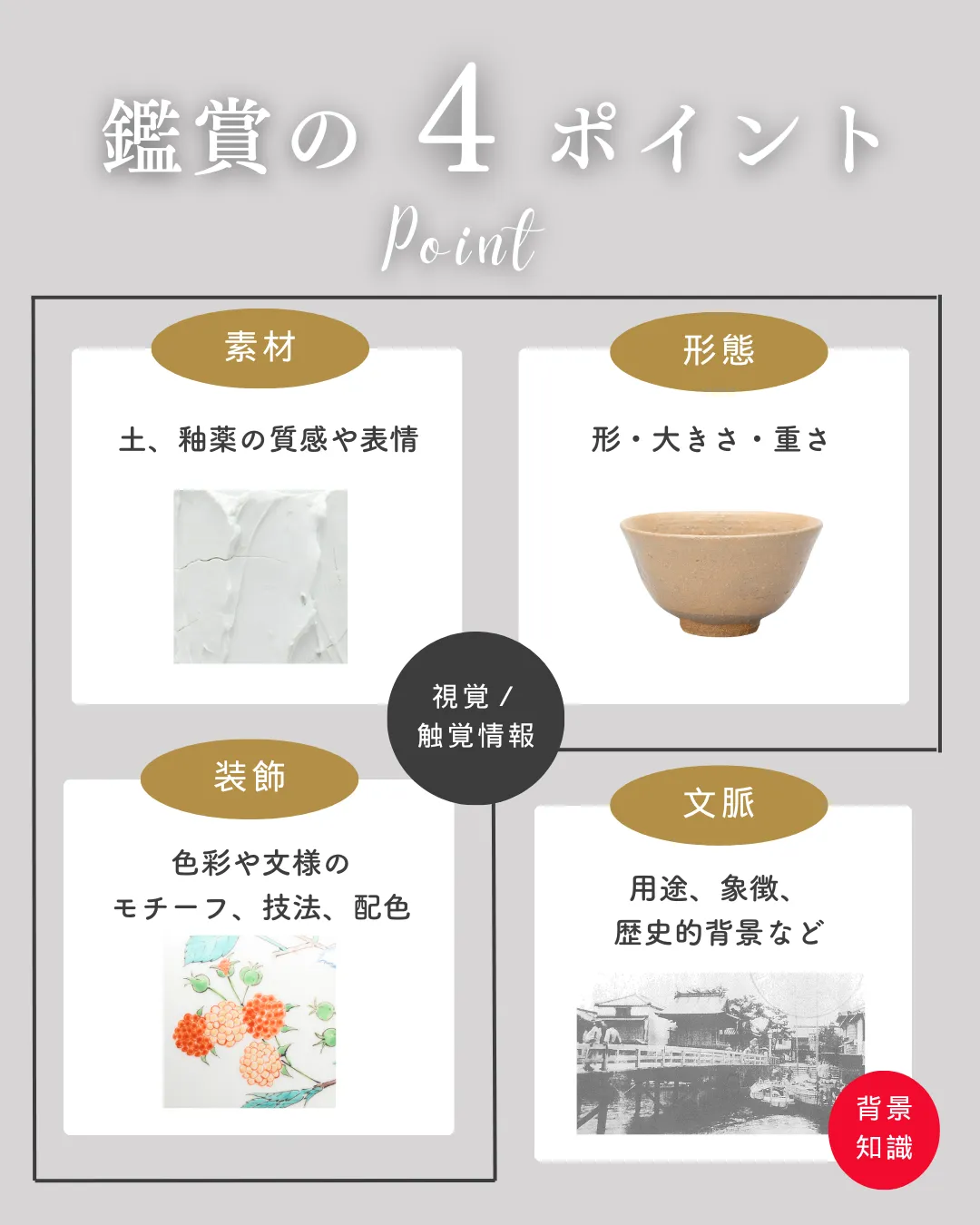
Appreciating the <Context>
Here, background knowledge enriches the experience.
While material, form, and decoration provide visual and tactile delight, historical context and cultural interpretation bring depth.
For example, the pairing of mountains and cherry blossoms conventionally alludes to Yoshino, celebrated in classical poetry; or a spool motif on Nabeshima ware evokes Tanabata, where offerings were made in hopes of excelling at weaving and sewing, in reference to the celestial princess Orihime.
The Joy of Seeing, Enriched by Knowing
We have introduced four key perspectives for appreciating ceramics. Begin with what the eye and hand perceive, then complement this with cultural and historical understanding, and the work itself will speak with greater eloquence. Welcome to the vast and profound world of ceramics.
▼Discover the artworks


